You get the letter in December. New ownership. New management. "Exciting improvements ahead." And then in January, the rate sheet arrives — and your slip fee just went up 15%.
If this sounds familiar, you're not alone. Across the US, marina after marina is being acquired by private equity firms, REITs, and institutional platforms. And the pattern that follows is remarkably consistent.
We track every marina transaction in the United States, and we hear from boaters on both sides of these deals regularly. Here's what the data — and the people living through it — actually show.
The Pattern: Year One After Acquisition
Based on boater reports from forums, marina associations, and direct accounts, here's what typically happens in the 12–24 months after an institutional buyer takes over a marina:
- Rates go up 10–20% in year one. Not inflation adjustments — real, above-market increases. Boaters at Safe Harbor marinas report 10–15% annual increases since the Brewer-era acquisitions, with some West Coast locations seeing 20%+ hikes.
- New fees appear. Liveaboard surcharges (up to 30% increases reported), mandatory membership programs, dinghy dock fees, pump-out service charges, mail box fees, increased security deposits — each one small, but they add up fast.
- Lease terms tighten. Month-to-month gets replaced by annual contracts. Subletting restrictions. Pet policies. Liveaboard caps. The flexibility that made marina life appealing starts disappearing.
- Cosmetic improvements arrive. New signage, a fresh coat of paint on the bathhouse, maybe a WiFi upgrade. The improvements are real — but they don't cost anywhere near what the rate increases generate.
The Numbers: What Boaters Are Actually Reporting
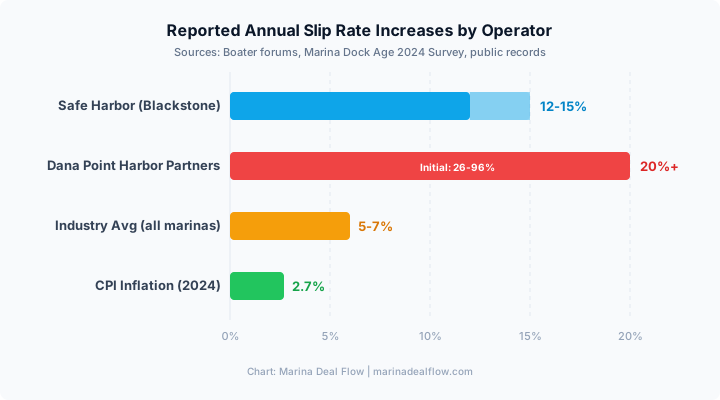
Here are specific data points from boater forums, public records, and industry surveys:
Safe Harbor Marinas (138+ locations)
Safe Harbor — now owned by Blackstone after a $5.65 billion acquisition — is the largest marina operator in the US. Boater reports from SailNet and Trawler Forum paint a consistent picture:
- 12–15% annual increases reported as the standard rate hike (SailNet forums)
- West Coast locations: 10–20% slip rate increases annually, with liveaboard fees up as much as 30%
- One boater reports a 45-foot slip at $921/month plus a $400/month liveaboard surcharge — before electricity, dinghy dock, storage, mail, pump-out, and an increased security deposit held without interest
- "There were some flat years under the Brewer era, but steady increases since the Safe Harbor buyout" — a common refrain across boating forums
Dana Point Harbor, California
The most dramatic case study in the country. When Dana Point Harbor Partners took over management of the harbor as part of a $600 million revitalization:
- Initial proposed rate increases: 26% to 96% depending on slip size
- Boaters filed a class-action lawsuit to block the increases (Voice of OC)
- A judge ruled boaters lacked standing — the appeal is ongoing
- 250 to 300 boaters left the marina. Many sold their boats entirely
- 2024 follow-up increases: 4.71% to 15.46% depending on slip length (Dana Point Times)
This is the extreme end, but it illustrates the playbook: acquire, raise rates, absorb departures (the waitlist fills the empty slips), and stabilize at a higher revenue baseline.
Industry-Wide Data
According to Marina Dock Age's 2024 Annual Survey of marina operators:
- 70% of marinas raised slip fees in 2024
- 60% increased service rates
- 84% reported rising expenses — but only 44% saw profit increases (down from 64% in 2023)
- 56% of marinas operate above 95% occupancy — meaning they have massive pricing power with almost no vacancy risk
That last number is the key. When your marina is 95%+ full with a waitlist, raising rates 15% doesn't cost you tenants — it just costs you goodwill. And institutional operators have decided that's a trade worth making.
The Part Nobody Wants to Hear: Some Increases Are Justified
Before you sharpen your pitchfork, here's the uncomfortable truth: marina operating costs have genuinely surged.
- Insurance: 85% of marina operators reported rising insurance costs in 2024. Excess marine renewal pricing has doubled or tripled in the past three years, driven by hurricane losses and coastal property reinsurance capacity shrinking. A Gulf Coast marina that paid $200K/year for coverage in 2021 might be paying $500K+ today — and that cost gets passed through.
- Deferred maintenance: Many family-owned marinas sold precisely because they were sitting on $2–5M in deferred dock, seawall, and piling repairs they couldn't afford. A full dock rebuild runs $5K–$15K per slip. When the new owner spends $3M on infrastructure the previous owner neglected for 15 years, a rate increase is a reasonable way to amortize that.
- Utilities and staffing: 71% reported rising utility costs; 70% faced higher staff costs. Running a marina 24/7 with proper security, pump-out compliance, and environmental management isn't cheap.
The honest answer is that some portion of every rate increase is legitimate. The question boaters should ask isn't "why are rates going up?" but "how much of this increase is cost-driven vs. profit-driven?" If your dock just got rebuilt, a 10% bump is reasonable. If nothing changed except the logo on the sign, it's a margin grab.
Why This Keeps Happening
To understand the rate increases, you have to understand the business model. When a PE firm buys a marina, here's the math they're running:
1. Marinas are bought on a multiple of income
A marina generating $1M in net operating income (NOI) at an 8% cap rate is worth $12.5M. If the buyer can raise NOI to $1.4M through rate increases — without spending much on capital improvements — that same marina is now worth $17.5M. That's a $5M value creation in 2–3 years just by raising rates.
2. There's nowhere else to go
There are approximately 10,500 marinas in the United States, and that number is barely growing. Permitting a new marina takes 5–10 years and requires USACE, state DEP, and local zoning approval. New waterfront is being absorbed by residential developers who can pay more.
So when your marina raises rates 15%, your options are: pay it, move to one of the few remaining independent marinas (which are also being acquired), or sell your boat.
3. Consolidation reduces competition
Our acquirer leaderboard shows that just two companies — Suntex (31 deals) and Safe Harbor (21 deals) — account for one in three tracked marina transactions. In many harbors and waterways, the same company now owns multiple marinas, reducing competitive pressure to keep rates low.
4. The investor expects a return
Blackstone paid $5.65B for Safe Harbor at roughly $113,000 per slip. They need to generate returns for their infrastructure fund LPs. Sun Communities made a 2.7x return selling to Blackstone after just 4 years of ownership. The next buyer will expect the same — and that return has to come from somewhere.
What Boaters Can Actually Do
Let's be honest: you can't stop a PE firm from raising rates at a marina they own. But you're not completely powerless.
Before the acquisition closes
- Lock in a long-term lease. If rumors start circulating about a sale (check our whispers page for early signals), try to negotiate a multi-year contract with fixed annual escalators — typically 3–5% — before new ownership takes over
- Organize. A marina tenants' association has more leverage than 200 individual boaters. At Dana Point, the boaters' association fought rate increases for years and delayed the worst of them, even if they ultimately lost in court
After new ownership takes over
- Document everything. Take photos of conditions before and after. Track every fee increase and every service reduction. If they promise improvements, get it in writing
- Know your lease. Many marina leases limit annual rate increases to a percentage or CPI adjustment. If the new owner is violating your existing lease terms, that's actionable
- Check local regulations. Some municipalities (especially in California) have marina rate oversight boards or public trust requirements that limit how much rates can be raised at publicly-owned waterfronts
- Consider alternatives early. Don't wait until you're priced out. Browse marina listings in your area — some independent marinas are still competitively priced, and knowing your options gives you negotiating leverage
When institutional ownership actually helps
Not every acquisition story is a horror story. Some marinas were genuinely underinvested — unsafe electrical systems, deteriorating docks, no pump-out compliance, fuel systems one storm away from an environmental disaster. When a well-capitalized operator comes in and spends $5M on real infrastructure, boaters benefit even if rates go up.
We've also seen cases where the previous owner was the one gouging — running a cash business with minimal reinvestment, charging whatever they could get away with because they owned the only marina on the lake. A professional operator can sometimes bring lower rates and better service through operational efficiency. It's just not the story you hear on the forums.
The pattern to watch for: did your new owner show up with a capital plan, or just a rate increase? That tells you everything.
The Bigger Picture
Marina consolidation isn't slowing down. Suntex just announced a $1.25 billion joint venture with Centerbridge Partners to acquire even more marinas. New platforms like Bowline, TopSide, and Monument Marine are building their own portfolios. Every quarter, more family-owned marinas get an offer they can't refuse.
For marina owners thinking about selling, this market is the best it's ever been — read our seller's guide for what to expect. For boaters, the best defense is information: know what's happening in your market, know who's buying, and know your options before the letter arrives.
We track every marina transaction, listing, and market move in the US. Subscribe free — you'll know about acquisitions in your area before most people at the dock do.